Marketing dashboards make activity visible. They do not automatically make business progress visible. A busy acquisition report can still leave the most important questions unanswered: which customers stayed, which offers created value, and where should the next investment go?
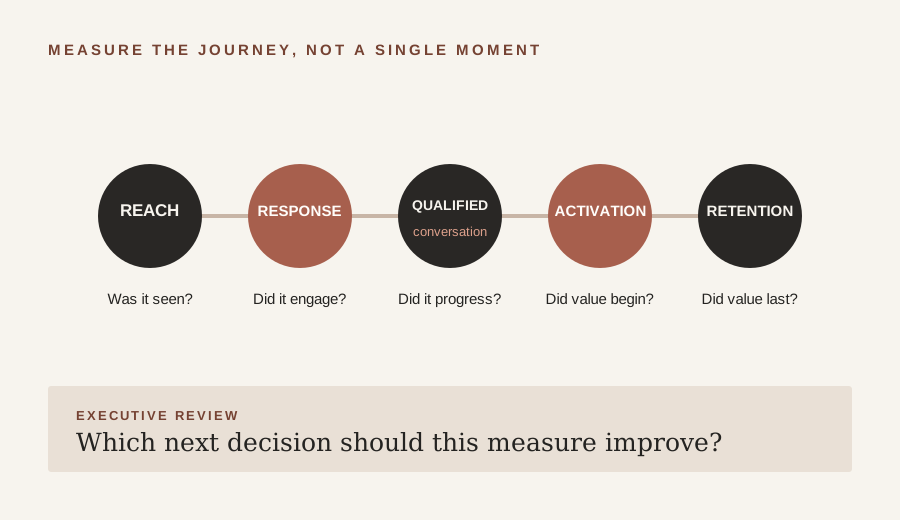
Metrics answer different questions
Impressions show delivery. Clicks show response. Leads show captured interest. Cost per lead shows the price of that capture. Return on ad spend connects selected media cost to attributed revenue within a defined method and time window. These measures are useful when their definitions are clear and the decision they inform is explicit.
The trap appears when a proxy becomes the goal. Lead volume can rise while qualification weakens. A channel can report an attractive return while later stages remain unmeasured. A lower acquisition cost can be a poor trade if the customer does not activate, renew or expand. The answer is not to discard channel metrics; it is to connect them to what happens next.
Draw the line beyond acquisition
A more useful measurement path follows the customer journey: acquisition, qualification, activation, retention and, where the business model supports it, expansion and lifetime value. The exact stages differ by business. What matters is that marketing, sales, product and finance agree on the definitions and the hand-offs.
At each stage, ask what event counts, which system records it, how long the journey takes and what the data cannot show. Make unattributed or unmatched activity visible. If the CRM and media platforms use different source labels, reconcile them before comparing spend with pipeline. A precise dashboard built on incompatible inputs is still a weak basis for a budget decision.
Keep attribution attached to its context
During the Lycamobile festive campaign series, new-customer acquisition revenue was GBP 90,728,644. Programmatic display delivered 19× ROAS. Those are meaningful measures when read with their scope intact: one describes campaign-series acquisition revenue; the other describes the return reported for that programmatic display activity.
That framing gives executives a useful starting point without pretending one number describes every part of growth. The next question is what the available customer, sales and financial data can establish about quality and value after acquisition.
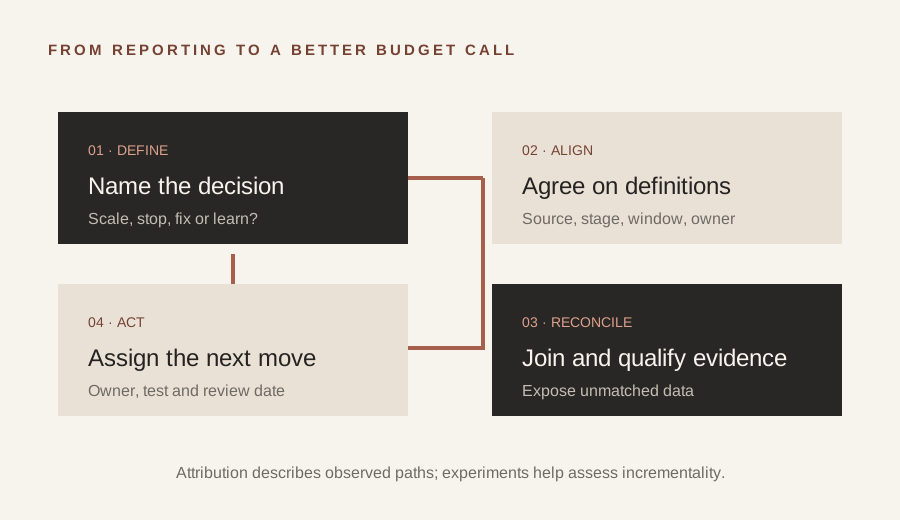
Make the next decision the centre of the report
A strong marketing review is organised around choices, not a parade of charts. Which audience should receive more attention? Which source produces conversations sales can advance? Where does qualification break down? What needs to be tested before shifting budget? The answers should make the assumptions and the owner of each next action clear.
When teams connect acquisition to customer and commercial outcomes, channel reporting becomes more useful. It helps leadership decide what to scale, what to improve and what is still unknown. That is a better standard for marketing visibility than counting activity alone. For a practical example of spend and CRM data reconciled around qualified conversations, explore the Pipeline IQ prototype.