Real-estate marketing often begins with demographic categories: nationality, location, age or household profile. Those details can help teams plan distribution, understand service requirements and organise research. They are a starting point, not a complete explanation of why a person considers an investment.
Move from category to motivation
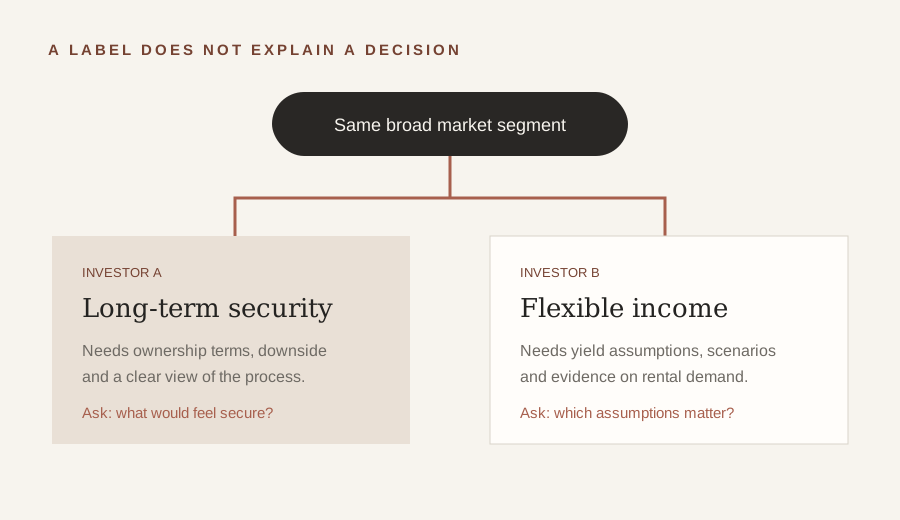
Two people in the same demographic segment can approach a property decision with different priorities. One may value long-term security; another may be comparing potential income, flexibility or a future home. One may want extensive evidence before speaking to sales; another may need a clear account of the buying process. These are examples of questions to investigate, not assumptions to attach to a passport.
Psychographic segmentation looks for motivations, decision criteria, attitudes to risk, time horizons and information needs. It works best when grounded in customer research, actual conversations and observed behaviour. The goal is not to put buyers into a new set of stereotypes. It is to make the next interaction more relevant.
Use insight to change the conversation
A useful segment should change what the team does. It may affect which questions a campaign asks, what evidence a sales conversation brings forward, how content explains a decision, or when a prospect is ready for follow-up. If a segment label changes nothing in the experience, it is unlikely to help a buyer or a commercial team.
At Sobha, psychographic segmentation was the largest contribution to a 36% improvement in lead-to-qualified-conversation conversion between June and November 2019. The outcome was a change in qualified conversations, not a claim about bookings or completed sales. The practical lesson is to connect audience understanding to the specific stage the team is trying to improve.
Build a responsible learning loop
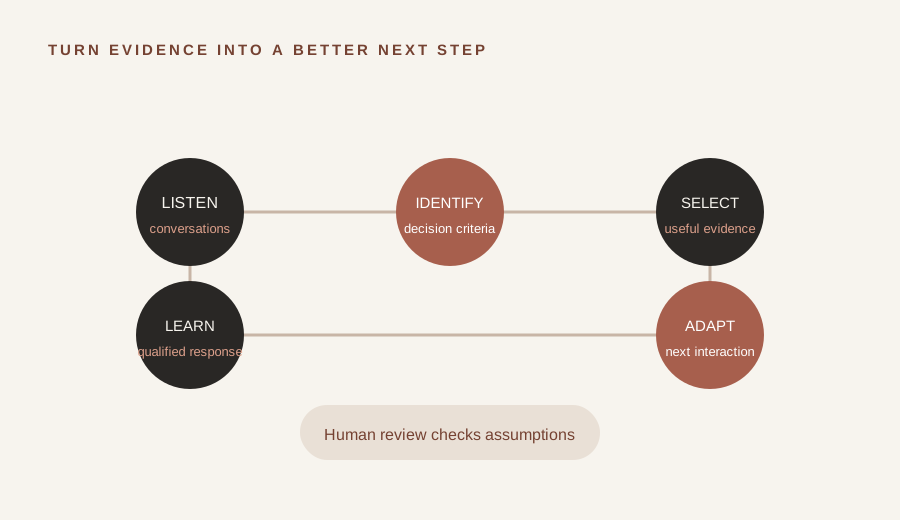
Start with open questions and qualitative evidence. Look for patterns in what investors are trying to accomplish, what makes a decision feel credible, and what information is missing. Compare those patterns with CRM stages and sales feedback. Keep sample limits and data quality in view, and allow a person to correct a mistaken assumption.
Then test whether the insight improves the intended interaction: the relevance of a conversation, the quality of a qualification step or the clarity of the material a buyer receives. Keep the measure close to the change. Avoid using a rise in activity as proof of better investor understanding.
Turn a framework into a practical tool
Investor IQ is a self-directed prototype that applies a psychographic framework to an investor conversation profile and structures the result as a brief. It uses an LLM and remains a prototype, rather than a client deployment or evidence of investment outcomes. Its purpose is to explore how a defined way of thinking might support more consistent preparation.
The underlying principle extends beyond real estate: understand the person’s decision, make the evidence useful and give the team a better next question. More relevant investor conversations begin with curiosity, not a shortcut from nationality to motive. The Investor IQ prototype explores how this psychographic lens can structure a conversation brief for human review.