Many organisations begin an AI conversation with the tool: what can it generate, automate or summarise? A more durable starting point is the decision that needs support. What does a person need to understand or do, and what expertise should guide the work?
Start with the thinking
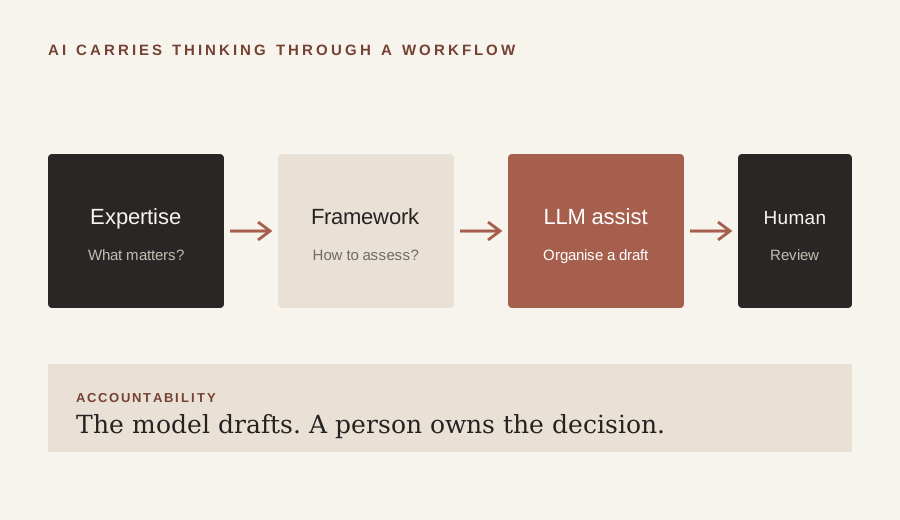
Domain expertise gives a workflow its shape. It helps distinguish useful evidence from noise, identify which questions matter and define what a good result should contain. A structured framework makes that expertise easier to explain and apply. AI can then support parts of the process that involve organising information, drafting or translating a pattern into a usable format.
Without that structure, a fluent output can still be irrelevant. With it, a team has a clearer way to review the result, spot gaps and decide what to do next. The framework should be visible enough that people can challenge it and improve it.
Investor IQ as a working example
Investor IQ explores this sequence in real-estate investor marketing. It takes a conversation profile and uses an LLM to create a structured brief based on a psychographic framework. The framework supplies the lens; the language model helps organise the response.
This is a self-directed prototype, not a client deployment. Its output should be treated as a draft for human review, not as a verified account of an investor’s intentions. A person needs to check whether the inputs are adequate, whether the brief reflects the conversation and whether any recommendation is appropriate before acting on it.
Choose the right amount of AI
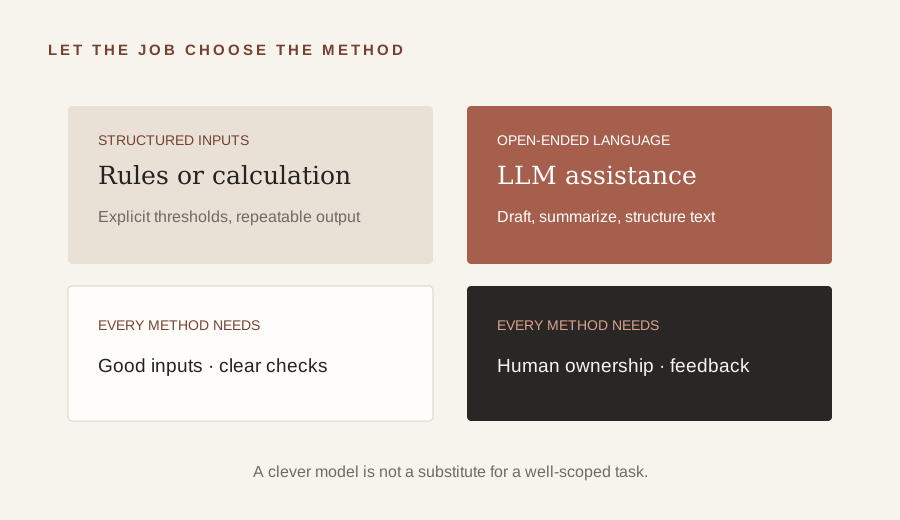
Not every business question needs a language model. Some tasks are better served by transparent rules and deterministic calculations. Pipeline IQ, for example, reconciles CRM pipeline exports with paid-media spend using a deterministic calculation engine. Investor IQ uses an LLM because the prototype is structuring a conversation profile into a brief.
The method should follow the job. A rule-based workflow can make a calculation reproducible. An LLM can help organise open-ended language. Either way, teams need to know what information enters, how the result is produced, where it can fail and who owns the final decision.
Scale judgement, not just output
Before adopting an AI-enabled workflow, define a small set of useful checks: Does it help someone prepare faster? Does the output make the next action clearer? Can the user trace important points to the supplied information? How often does a human need to correct or discard it? These questions keep the evaluation connected to work rather than to novelty.
Strategic thinking remains the source of direction. AI can help carry a well-designed approach into more consistent workflows, but only when teams keep context, review and accountability in the process. That is how a useful prototype becomes a better question about operating practice, rather than a claim that the technology has solved the problem. Investor IQ makes the approach tangible: an LLM structures a draft from a defined framework, and a person remains responsible for review.